
eso2415 — Tlačová správa

Vesmírna zaujímavosť: Nájdená najvzdialenejšia galaxia s rotujúcim diskom
07. október 2024
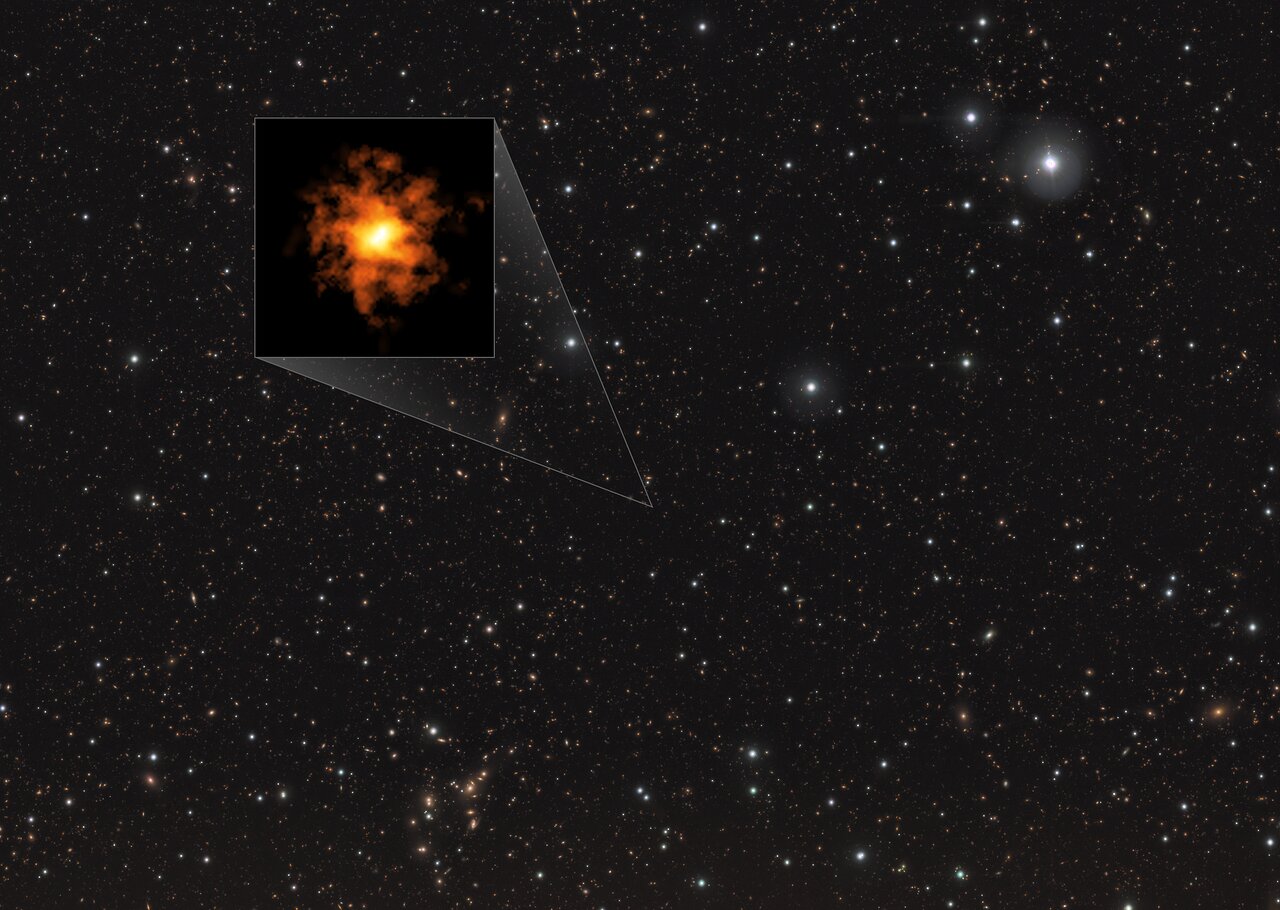
Vedci objavili doposiaľ najvzdialenejšiu galaxiu podobnú Mliečnej dráhe. Táto disková galaxia prezývaná REBELS-25 ukrýva štruktúry ako súčasné galaxie, pričom sa na ňu pozeráme v podobe, ktorú mala iba 700 miliónov rokov po vzniku vesmíru. To je prekvapujúce, pretože podľa našich súčasných znalostí o vzniku galaxií, pôsobia rané galaxie na pohľad chaotickejšie. Rotáciu a štruktúru galaxie REBELS-25 sa podarilo odhaliť pomocou sústavy ALMA (Atacama Large Millimeter/submillimeter Array), ktorej partnerom je Európske južné observatórium (ESO).
Galaxie, ktoré vidíme dnes, prešli dlhú cestu od svojich chaotických, nesúrodých náprotivkov, ktoré astronómovia zvyčajne pozorujú v ranom vesmíre. „Podľa nášho chápania formovania galaxií očakávame, že väčšina raných galaxií bude malá a neusporiadaná,“ hovorí Jacqueline Hodge, astronómka z Leidenskej univerzity v Holandsku a spoluautorka štúdie.
Tieto nesúrodé rané galaxie sa navzájom spájajú a potom veľmi pomaly získavajú, čím ďalej tým hladšiu podobu. Súčasné teórie naznačujú, že aby galaxia bola tak usporiadaná ako naša Mliečna dráha – rotujúci disk s úhľadnými štruktúrami, ako sú špirálové ramená – museli by uplynúť miliardy rokov vývoja. Objav galaxie REBELS-25 však tento časový rámec spochybňuje.
V štúdii, ktorá bola prijatá na publikáciu v časopise Monthly Notice of the Royal Astronomical Society, astronómovia preukázali, že REBELS-25 je najvzdialenejšia silne rotujúca disková galaxia, aká bola kedy objavená. Svetlo, ktoré k nám z tejto galaxie prichádza, bolo vyžarované v čase, keď bol vesmír starý iba 700 miliónov rokov – čo je len päť percent jeho súčasného veku (13,8 miliardy), preto je usporiadaná rotácia galaxie REBELS-25 takým prekvapením. „Vidieť galaxiu, podobnú našej Mliečnej dráhe, ktorá má silnú rotačnú dominanciu, spochybňuje naše chápanie toho, ako rýchlo sa galaxie v ranom vesmíre vyvíjali do usporiadanej galaxii dnešného vesmíru,“ hovorí Lucie Rowland, doktorandka na Leidenskej univerzite a prvá autorka štúdie.
REBELS-25 bola pôvodne objavená v predchádzajúcich pozorovaniach tým istým tímom, ktorý sa tiež uskutočnil pomocou rádioteleskopu ALMA, ktorý sa nachádza v čílskej púšti Atacama. Skupina už vtedy rozpoznala náznaky rotácie, ale rozlíšenie dát nebolo dostatočne vysoké, aby mohla s istotou objav potvrdiť. Skupina vykonala preto nadväzujúce pozorovania s vyšším rozlíšením, ktoré potvrdili, že ide skutočne o galaxiu lámajúcu rekordy. „ALMA je jediným súčasným teleskopom s dostatočnou citlivosťou a rozlíšením, ktorý umožňuje dosiahnuť takýto výsledok,“ hovorí Renske Smit, výskumník z Liverpool John Moores University vo Veľkej Británii a tiež spoluautor štúdie.
Prekvapivo, údaje tiež naznačili aj ďalšie rozvinuté štruktúry podobných, tým v Mliečnej dráhe, ako je stredová pretiahnutá priečka a dokonca aj špirálové ramená, aj keď na ich potvrdenie budú potrebné ďalšie pozorovania. „Nájdenie ďalších dôkazov o vyvinutejších štruktúrach by bolo úžasným objavom, pretože by sa jednalo o najvzdialenejšiu galaxiu s takými štruktúrami, ktorá bola doteraz pozorovaná,“ hovorí Rowland.
Tieto budúce pozorovania REBELS-25 spolu s ďalšími objavmi skorých rotujúcich galaxií potenciálne zmenia naše chápanie raného formovania galaxií a vývoja vesmíru ako takého.
More information
This research is presented in a paper entitled “REBELS-25: Discovery of a dynamically cold disc galaxy at z=7.31” to appear in Monthly Notices of the Royal Astronomical Society.
The observations were conducted as part of the ALMA Large Program REBELS: Reionization Era Bright Emission Lines Survey.
The team is composed of L. E. Rowland (Leiden Observatory, Leiden University, the Netherlands [Leiden]), J. Hodge (Leiden), R. Bouwens (Leiden), P. M. Piña (Leiden), A. Hygate (Leiden), H. Algera (Astrophysical Science Center, Hiroshima University, Japan [HASC]; National Astronomical Observatory of Japan, Japan), M. Aravena (Núcleo de Astronomía, Facultad de Ingeniería y Ciencias, Universidad Diego Portales, Chile), R. Bowler (Jodrell Bank Centre for Astrophysics, University of Manchester, UK), E. da Cunha (International Centre for Radio Astronomy Research, University of Western Australia, Australia; ARC Centre of Excellence for All Sky Astrophysics in 3 Dimensions), P. Dayal (Kapteyn Astronomical Institute, University of Groningen, the Netherlands), A. Ferrara (Scuola Normale Superiore, Italy [SNS]), T. Herard-Demanche (Leiden), H. Inami (HASC), I. van Leeuwen (Leiden), I. de Looze (Sterrenkundig Observatorium, Ghent University, Belgium), P. Oesch (Department of Astronomy, University of Geneva, Switzerland; Cosmic Dawn Center, Denmark), A. Pallottini (SNS), S. Phillips (Astrophysics Research Institute, Liverpool John Moores University, UK [LJMU]), M. Rybak (Faculty of Electrical Engineering, Delft University of Technology, the Netherlands; Leiden; Netherlands Institute for Space Research, the Netherlands), S. Schouws (Leiden), R. Smit (LJMU), L. Sommovigo (Center for Computational Astrophysics, Flatiron Institute, USA), M. Stefanon (Departament d’Astronomia i Astrofísica, Universitat de València, Spain; Grupo de Astrofísica Extragaláctica y Cosmología, Universitat de València, Spain), P. van der Werf (Leiden).
The Atacama Large Millimeter/submillimeter Array (ALMA), an international astronomy facility, is a partnership of ESO, the U.S. National Science Foundation (NSF) and the National Institutes of Natural Sciences (NINS) of Japan in cooperation with the Republic of Chile. ALMA is funded by ESO on behalf of its Member States, by NSF in cooperation with the National Research Council of Canada (NRC) and the National Science and Technology Council (NSTC) in Taiwan and by NINS in cooperation with the Academia Sinica (AS) in Taiwan and the Korea Astronomy and Space Science Institute (KASI). ALMA construction and operations are led by ESO on behalf of its Member States; by the National Radio Astronomy Observatory (NRAO), managed by Associated Universities, Inc. (AUI), on behalf of North America; and by the National Astronomical Observatory of Japan (NAOJ) on behalf of East Asia. The Joint ALMA Observatory (JAO) provides the unified leadership and management of the construction, commissioning and operation of ALMA.
The European Southern Observatory (ESO) enables scientists worldwide to discover the secrets of the Universe for the benefit of all. We design, build and operate world-class observatories on the ground — which astronomers use to tackle exciting questions and spread the fascination of astronomy — and promote international collaboration for astronomy. Established as an intergovernmental organisation in 1962, today ESO is supported by 16 Member States (Austria, Belgium, Czechia, Denmark, France, Finland, Germany, Ireland, Italy, the Netherlands, Poland, Portugal, Spain, Sweden, Switzerland and the United Kingdom), along with the host state of Chile and with Australia as a Strategic Partner. ESO’s headquarters and its visitor centre and planetarium, the ESO Supernova, are located close to Munich in Germany, while the Chilean Atacama Desert, a marvellous place with unique conditions to observe the sky, hosts our telescopes. ESO operates three observing sites: La Silla, Paranal and Chajnantor. At Paranal, ESO operates the Very Large Telescope and its Very Large Telescope Interferometer, as well as survey telescopes such as VISTA. Also at Paranal ESO will host and operate the Cherenkov Telescope Array South, the world’s largest and most sensitive gamma-ray observatory. Together with international partners, ESO operates ALMA on Chajnantor, a facility that observes the skies in the millimetre and submillimetre range. At Cerro Armazones, near Paranal, we are building “the world’s biggest eye on the sky” — ESO’s Extremely Large Telescope. From our offices in Santiago, Chile we support our operations in the country and engage with Chilean partners and society.
Contacts
Lucie Rowland
Leiden Observatory, University of Leiden
Leiden, The Netherlands
Tel: +31 71 527 2727
Email: lrowland@strw.leidenuniv.nl
Jacqueline Hodge
Leiden Observatory, University of Leiden
Leiden, The Netherlands
Tel: +31 71 527 8450
Email: hodge@strw.leidenuniv.nl
Renske Smit
Astrophysics Research Institute, Liverpool John Moores University
Liverpool, UK
Tel: +44-151-231-2922
Email: R.Smit@ljmu.ac.uk
Bárbara Ferreira
ESO Media Manager
Garching bei München, Germany
Tel: +49 89 3200 6670
Cell: +49 151 241 664 00
Email: press@eso.org
Pôvodný článok: https://www.eso.org/public/news/eso2415/