
eso2413 — Tlačová správa

Ďalekohľady ESO zachytili doteraz najpodrobnejšiu infračervenú mapu našej Mliečnej dráhy
26. september 2024
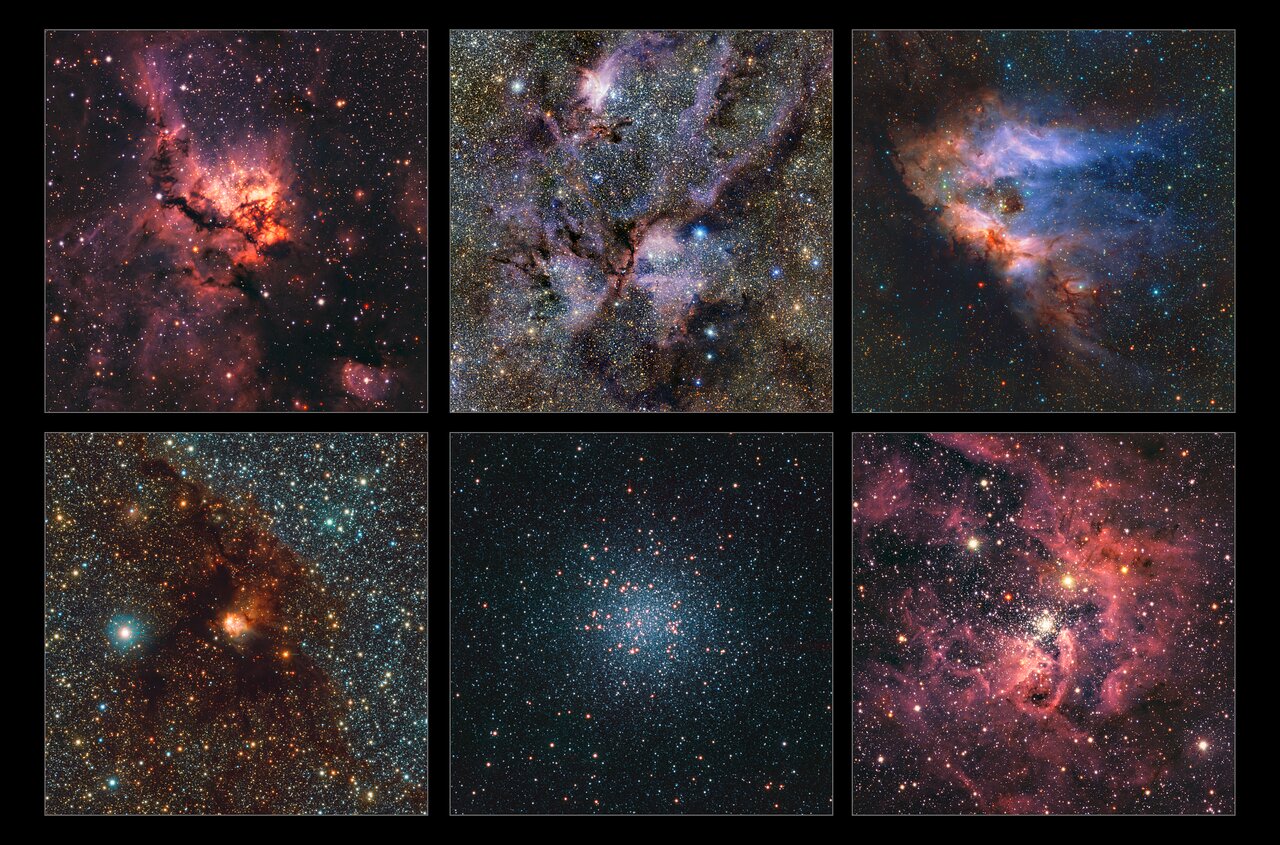
Astronómovia zverejnili gigantickú infračervenú mapu Mliečnej dráhy, ktorá obsahuje viac ako 1,5 miliardy objektov – ide o najpodrobnejšiu mapu, ktorá bola kedy vytvorená. Pomocou ďalekohľadu VISTA Európskeho južného observatória skupina astronómov sledovala centrálne oblasti našej Galaxie viac ako 13 rokov. So svojimi 500 terabajtmi údajov ide o najväčší pozorovací projekt, aký sa kedy pomocou ďalekohľadu ESO uskutočnil.
„Priniesli sme toľko objavov, že sme navždy zmenili pohľad na našu Galaxiu,“ hovorí Dante Minniti, astrofyzik z čilskej Universidad Andrés Bello v Čile, ktorý viedol celkový projekt.
Táto rekordná mapa obsahuje 200 000 snímok vyhotovených pomocou prehliadkového ďalekohľadu ESO VISTA (Visible and Infrared Survey Telescope for Astronomy ). Ďalekohľad je umiestnený na observatóriu ESO Paranal v Čile a jeho hlavnou úlohou je mapovať rozsiahle oblasti oblohy. Skupina použila infračervenú kameru VISTA VIRCAM, ktorá dokáže preniknúť cez prach a plyn, ktorými je naša Galaxia prepletená. Tak je teda schopný vidieť žiarenie aj v najskrytejších miestach Mliečnej dráhy a otvára tým jedinečné okno do nášho galaktického okolia.
Tento gigantický súbor údajov [1] pokrýva oblasť oblohy ekvivalentnú 8600 mesiacom v splne a obsahuje asi 10-krát viac objektov ako predchádzajúca mapa vydaná tou istou skupinou v roku 2012. Zahŕňa mladé hviezdy, ktoré sa často nachádzajú v prachových kuklách, a guľové hviezdokopy – husté skupiny miliónov najstarších hviezd v Mliečnej dráhe. Pri pozorovaní v infračervenom svetle môže VISTA tiež nájsť veľmi chladné objekty, ktoré na týchto vlnových dĺžkach žiaria, ako sú hnedí trpaslíci („neúspešné“ hviezdy, u ktorých nedošlo k zapáleniu jadrovej fúzie) alebo voľne plávajúce planéty, ktoré neobiehajú okolo žiadnej hviezdy.
Pozorovanie začalo v roku 2010 a skončilo v prvej polovici roku 2023, celkovo trvalo 420 nocí. Mnohonásobným pozorovaním každej časti oblohy bola skupina schopná nielen určiť polohu týchto objektov, ale tiež sledovať, ako sa pohybujú a či sa mení ich jasnosť. Zmapovali hviezdy, ktorých jasnosť sa periodicky mení a môžu byť použité ako vesmírne pravítka na meranie vzdialeností [2]. Vďaka tomu získali presný 3D pohľad na vnútorné oblasti Mliečnej dráhy, ktoré boli predtým skryté v prachu. Výskumníci tiež sledovali tzv. hyperrýchle hviezdy – rýchlo sa pohybujúce hviezdy katapultované z centrálnej oblasti Mliečnej dráhy po blízkom stretnutí so supermasívnou čiernou dierou, ktorá tam číha.
Nová mapa obsahuje údaje získané ako súčasť prieskumu VISTA Variables in the Vía Láctea (VVV) [3] a jeho sprievodného projektu the VVV eXtended (VVVX) . „Za projektom stojí obrovské úsilie, ktoré bolo možné vďaka výbernej skupine,“ hovorí Roberto Saito, astrofyzik z Universidade Federal de Santa Catarina v Brazílii a hlavný autor článku, ktorý bol dnes publikovaný v časopise Astronomy & Astrophysics.
Na základe prieskumov VVV a VVVX bolo už publikovaných viac ako 300 vedeckých článkov. Teraz sú už prieskumy dokončené a vedecké skúmanie zhromaždených dát bude pokračovať ešte niekoľko desaťročí
Medzitým sa Paranal Observatory ESO pripravuje na budúcnosť: VISTA bude doplnená o nový prístroj 4MOST a veľmi veľký ďalekohľad ESO (VLT) dostane prístroj MOONS. Spoločne prinesú spektrá miliónov objektov a možno očakávať nespočetné množstvo objavov.
Poznámky
[1] Dátový súbor je príliš veľký na to, aby mohol byť zverejnený ako jeden snímok, ale spracované dáta a katalóg objektov sú k dispozícii na vedeckom portáli ESO Science Portal.
[2] Jedným zo spôsobov, ako zmerať vzdialenosť hviezdy, je porovnať jej jasnosť pri pohľade zo Zeme s tým, aká jasná je v skutočnosti, čo ale často nie je známe. Niektoré typy hviezd periodicky menia svoju jasnosť a existuje veľmi silná súvislosť medzi tým, ako rýchlo to robia, a tým, ako sú jasné. Meranie týchto fluktuácií umožňuje astronómom zistiť, ako sú tieto hviezdy jasné, a teda ako ďaleko od nás leží.
[3] Vía Láctea je latinský názov pre Mliečnu dráhu.
More information
This research was presented in a paper entitled “The VISTA Variables in the Vía Láctea eXtended (VVVX) ESO public survey: Completion of the observations and legacy” published in Astronomy & Astrophysics (https://doi.org/10.1051/0004-6361/202450584). Data DOI: VVV, VVVX.
The team is composed of R. K. Saito (Departamento de Física, Universidade Federal de Santa Catarina, Florianópolis, Brazil [UFSC]), M. Hempel (Instituto de Astrofísica, Dep. de Ciencias Físicas, Facultad de Ciencias Exactas, Universidad Andres Bello, Providencia, Chile [ASTROUNAB] and Max Planck Institute for Astronomy, Heidelberg, Germany), J. Alonso-García (Centro de Astronomía, Universidad de Antofagasta, Antofagasta, Chile [CITEVA] and Millennium Institute of Astrophysics, Providencia, Chile [MAS]), P. W. Lucas (Centre for Astrophysics Research, University of Hertfordshire, Hatfield, United Kingdom [CAR]), D. Minniti (ASTROUNAB; Vatican Observatory, Vatican City, Vatican City State [VO] and UFSC), S. Alonso (Departamento de Geofísica y Astronomía, CONICET, Facultad de Ciencias Exactas, Físicas y Naturales, Universidad Nacional de San Juan, Rivadavia, Argentina [UNSJ-CONICET]), L. Baravalle (Instituto de Astronomía Teórica y Experimental, Córdoba, Argentina [IATE-CONICET]; Observatorio Astronómico de Córdoba, Universidad Nacional de Córdoba, Argentina [OAC]), J. Borissova (Instituto de Física y Astronomía, Universidad de Valparaíso, Valparaíso, Chile [IFA-UV] and MAS), C. Caceres (ASTROUNAB), A. N. Chené (Gemini Observatory, Northern Operations Center, Hilo, USA), N. J. G. Cross (Wide-Field Astronomy Unit, Institute for Astronomy, University of Edinburgh, Royal Observatory, Edinburgh, United Kingdom), F. Duplancic (UNSJ-CONICET), E. R. Garro (European Southern Observatory, Vitacura, Chile [ESO Chile]), M. Gómez (ASTROUNAB), V. D. Ivanov (European Southern Observatory, Garching bei München [ESO Germany]), R. Kurtev (IFA-UV and MAS), A. Luna (INAF – Osservatorio Astronomico di Capodimonte, Napoli, Italy [INAF- OACN]), D. Majaess (Mount Saint Vincent University, Halifax, Canada), M. G. Navarro (INAF – Osservatorio Astronomico di Roma, Italy [INAF-OAR]), J. B. Pullen (ASTROUNAB), M. Rejkuba (ESO Germany), J. L. Sanders (Department of Physics and Astronomy, University College London, London, United Kingdom), L. C. Smith (Institute of Astronomy, University of Cambridge, Cambridge, United Kingdom), P. H. C. Albino (UFSC), M. V. Alonso (IATE-CONICET and OAC), E. B. Amôres (Departamento de Física, Universidade Estadual de Feira de Santana, Feira de Santana, Brazil), E. B. R. Angeloni (Gemini Observatory/NSF’s NOIRLab, La Serena, Chile [NOIRLab]), J. I. Arias (Departamento de Astronomía, Universidad de La Serena, La Serena, Chile [ULS]), M. Arnaboldi (ESO Germany), B. Barbuy (Universidade de São Paulo, São Paulo, Brazil), A. Bayo (ESO Germany), J. C. Beamin (ASTROUNAB and Fundación Chilena de Astronomía, Santiago, Chile), L. R. Bedin (Istituto Nazionale di Astrofisica, Osservatorio Astronomico di Padova, Padova, Italy [INAF-OAPd]), A. Bellini (Space Telescope Science Institute, Baltimore, USA [STScI]), R. A. Benjamin (Department of Physics, University of Wisconsin-Whitewater, Whitewater, USA), E. Bica (Departamento de Astronomia, Instituto de Física, Porto Alegre, Brazil [IF – UFRGS]), C. J. Bonatto (IF – UFRGS), E. Botan (Instituto de Ciências Naturais, Humanas e Sociais, Universidade Federal de Mato Grosso, Sinop, Brazil), V. F. Braga (INAF-OAR), D. A. Brown (Vatican Observatory, Tucson, USA), J. B. Cabral (IATE-CONICET and Gerencia De Vinculación Tecnológica, Comisión Nacional de Actividades Espaciales, Córdoba, Argentina), D. Camargo (Colégio Militar de Porto Alegre, Ministério da Defesa, Exército Brasileiro, Brazil), A. Caratti o Garatti (INAF- OACN), J. A. Carballo-Bello (Instituto de Alta Investigación, Universidad de Tarapacá, Arica, Chile [IAI-UTA]), M.Catelan (Instituto de Astrofísica, Pontificia Universidad Católica de Chile, Santiago, Chile [Instituto de Astrofísica UC]; MAS and Centro de Astro-Ingeniería, Pontificia Universidad Católica de Chile, Santiago, Chile [AIUC]), C. Chavero (OAC and Consejo Nacional de Investigaciones Científica y Técnicas, Ciudad Autónoma de buenos Aires, Argentina [CONICET]), M. A. Chijani (ASTROUNAB), J. J. Clariá (OAC and CONICET), G. V. Coldwell (UNSJ-CONICET), C. Contreras Peña (Department of Physics and Astronomy, Seoul National University, Seoul, Republic of Korea and Research Institute of Basic Sciences, Seoul National University, Seoul, Republic of Korea), C. R. Contreras Ramos (Instituto de Astrofísica UC and MAS), J. M. Corral-Santana (ESO Chile), C. C. Cortés (Departamento de Tecnologías Industriales, Faculty of Engineering, Universidad de Talca, Curicó, Chile), M. Cortés-Contreras (Departamento de Física de la Tierra y Astrofísica & Instituto de Física de Partículas y del Cosmos de la UCM, Facultad de Ciencias Físicas, Universidad Complutense de Madrid, Madrid, Spain), P. Cruz (Centro de Astrobiología, CSIC-INTA, Madrid, Spain [CAB]), I. V. Daza-Perilla (CONICET; IATE-CONICET and Facultad de Matemática, Astronomía, Física y Computación, Universidad Nacional de Córdoba, Córdoba, Argentina), V. P. Debattista (University of Central Lancashire, Preston, United Kingdom), B. Dias (ASTROUNAB), L. Donoso (Instituto de Ciencias Astronómicas, de la Tierra y del Espacio, San Juan, Argentina), R. D’Souza (VO), J. P. Emerson (Astronomy Unit, School of Physical and Chemical Sciences, Queen Mary University of London, London, United Kingdom), S. Federle (ESO Chile and ASTROUNAB), V. Fermiano (UFSC), J. Fernandez (UNSJ-CONICET), J. G. Fernández-Trincado (Instituto de Astronomía, Universidad Católica del Norte, Antofagasta, Chile [IA-UCN]), T. Ferreira (Department of Astronomy, Yale University, New Haven, USA), C. E. Ferreira Lopes (Instituto de Astronomía y Ciencias Planetarias, Universidad de Atacama, Copiapó, Chile [INCT] and MAS), V. Firpo (NOIRLab), C. Flores-Quintana (ASTROUNAB and MAS), L. Fraga (Laboratorio Nacional de Astrofísica, Itajubá, Brazil), D.Froebrich (Centre for Astrophysics and Planetary Science, School of Physics and Astronomy, University of Kent, Canterbury, United Kingdom), D. Galdeano (UNSJ-CONICET), I. Gavignaud (ASTROUNAB), D. Geisler (Departamento de Astronomía, Universidad de Concepción, Chile [UdeC]; Instituto Multidisciplinario de Investigación y Postgrado, Universidad de La Serena, Chile [IMIP-ULS] and ULS), O. E.Gerhard (Max Planck Institute for Extraterrestrial Physics, Germany [MPE]), W. Gieren (UdeC), O. A. Gonzalez (UK Astronomy Technology Centre, Royal Observatory Edinburgh, Edinburgh, United Kingdom), L. V. Gramajo (OAC and CONICET), F. Gran (Université Côte d’Azur, Observatoire de la Côte d’Azur, CNRS, Laboratoire Lagrange, Nice, France [Lagrange]), P. M. Granitto (Centro Internacional Franco Argentino de Ciencias de la Información y de Sistemas, Rosario, Argentina), M. Griggio (INAF-OAPd; Dipartimento di Fisica, Università di Ferrara, Ferrara, Italy and STScI), Z. Guo (IFA-UV and MAS), S. Gurovich (IATE-CONICET and Western Sydney University, Kingswood, Australia), M. Hilker (ESO Germany), H. R. A. Jones (CAR), R. Kammers (UFSC), M. A. Kuhn (CAR), M. S. N. Kumar (Centro de Astrofísica da Universidade do Porto, Porto, Portugal), R. Kundu (Miranda House, University of Delhi, India and Inter University centre for Astronomy and Astrophysics, Pune, India), M. Lares (IATE-CONICET), M. Libralato (INAF-OAPd), E. Lima (Universidade Federal do Pampa, Uruguaiana, Brazil), T. J. Maccarone (Department of Physics & Astronomy, Texas Tech University, Lubbock, USA), P. Marchant Cortés (ULS), E. L. Martin (Instituto de Astrofisica de Canarias and Departamento de Astrofísica, Universidad de La Laguna, San Cristóbal de la Laguna, Spain), N. Masetti (Istituto Nazionale di Astrofisica, Osservatorio di Astrofisica e Scienza dello Spazio di Bologna, Bologna, Italy and ASTROUNAB), N. Matsunaga (Department of Astronomy, Graduate School of Science, The University of Tokyo, Japan), F. Mauro (IA-UCN), I. McDonald (Jodrell Bank Centre for Astrophysics, The University of Manchester, UK [JBCA]), A. Mejías (Departamento de Astronomía, Universidad de Chile, Las Condes, Chile), V. Mesa (IMIP-ULS; Association of Universities for Research in Astronomy, Chile, Grupo de Astrofísica Extragaláctica-IANIGLA; CONICET, and Universidad Nacional de Cuyo, Mendoza, Argentina), F. P. Milla-Castro (ULS), J. H. Minniti (Department of Physics and Astronomy, Johns Hopkins University, Baltimore, USA), C. Moni Bidin (IA-UCN), K. Montenegro (Clínica Universidad de los Andes, Santiago, Chile), C. Morris (CAR), V. Motta (OAC), F. Navarete (SOAR Telescope/NSF’s NOIRLab, La Serena, Chile), C. Navarro Molina (Centro de Docencia Superior en Ciencias Básicas, Universidad Austral de Chile, Puerto Montt, Chile), F. Nikzat (Instituto de Astrofísica UC and MAS), J. L. NiloCastellón (IMIP-ULS and ULS), C. Obasi (IA-UCN and Centre for Basic Space Science, University of Nigeria, Nsukka, Nigeria), M. Ortigoza-Urdaneta (Departamento de Matemática, Universidad de Atacama, Copiapó, Chile), T. Palma (OAC), C. Parisi (OAC and IATE-CONICET), K. Pena Ramírez (NSF NOIRLab/Vera C. Rubin Observatory, La Serena, Chile), L. Pereyra (IATE-CONICET), N. Perez (UNSJ-CONICET), I. Petralia (ASTROUNAB), A. Pichel (Instituto de Astronomía y Física del Espacio, Ciudad Autónoma de Buenos Aires, Argentina [IAFE-CONICET]), G. Pignata (IAI-UTA), S. Ramírez Alegría (CITEVA), A. F. Rojas (Instituto de Astrofísica UC, Instituto de Estudios Astrofísicos, Facultad de Ingeniería y Ciencias, Universidad Diego Portales, Santiago, Chile and CITEVA), D. Rojas (ASTROUNAB), A. Roman-Lopes (ULS), A. C. Rovero (IAFE-CONICET), S. Saroon (ASTROUNAB), E. O. Schmidt (OAC and IATE-CONICET), A. C. Schröder (MPE), M. Schultheis (Lagrange), M. A. Sgró (OAC), E. Solano (CAB), M. Soto (INCT), B. Stecklum (Thüringer Landessternwarte, Tautenburg, Germany), D. Steeghs (Department of Physics, University of Warwick, UK), M. Tamura (Department of Astronomy, Graduate School of Science, University of Tokyo; Astrobiology Center, Tokyo, Japan, and National Astronomical Observatory of Japan, Tokyo, Japan), P. Tissera (Instituto de Astrofísica UC and AIUC), A. A. R. Valcarce (Departamento de Física, Universidad de Tarapacá, Chile), C. A. Valotto (IATE-CONICET and OAC), S. Vasquez (Museo Interactivo de la Astronomía, La Granja, Chile), C. Villalon (IATE-CONICET and OAC), S. Villanova (UdeC), F. Vivanco Cádiz (ASTROUNAB), R. Zelada Bacigalupo (North Optics, La Serena, Chile), A. Zijlstra (JBCA and School of Mathematical and Physical Sciences, Macquarie University, Sydney, Australia), and M. Zoccali (Instituto de Astrofísica UC and MAS).
The European Southern Observatory (ESO) enables scientists worldwide to discover the secrets of the Universe for the benefit of all. We design, build and operate world-class observatories on the ground — which astronomers use to tackle exciting questions and spread the fascination of astronomy — and promote international collaboration for astronomy. Established as an intergovernmental organisation in 1962, today ESO is supported by 16 Member States (Austria, Belgium, Czechia, Denmark, France, Finland, Germany, Ireland, Italy, the Netherlands, Poland, Portugal, Spain, Sweden, Switzerland and the United Kingdom), along with the host state of Chile and with Australia as a Strategic Partner. ESO’s headquarters and its visitor centre and planetarium, the ESO Supernova, are located close to Munich in Germany, while the Chilean Atacama Desert, a marvellous place with unique conditions to observe the sky, hosts our telescopes. ESO operates three observing sites: La Silla, Paranal and Chajnantor. At Paranal, ESO operates the Very Large Telescope and its Very Large Telescope Interferometer, as well as survey telescopes such as VISTA. Also at Paranal ESO will host and operate the Cherenkov Telescope Array South, the world’s largest and most sensitive gamma-ray observatory. Together with international partners, ESO operates ALMA on Chajnantor, a facility that observes the skies in the millimetre and submillimetre range. At Cerro Armazones, near Paranal, we are building “the world’s biggest eye on the sky” — ESO’s Extremely Large Telescope. From our offices in Santiago, Chile we support our operations in the country and engage with Chilean partners and society.
Contacts
Roberto K. Saito
Universidade Federal de Santa Catarina
Florianópolis, Brazil
Email: roberto.saito@ufsc.br
Dante Minniti
Universidad Andrés Bello
Santiago, Chile
Email: vvvdante@gmail.com
Phil Lucas
University of Hertfordshire
Hartfield, United Kingdom
Email: p.w.lucas@herts.ac.uk
Juan Carlos Muñoz-Mateos
ESO Media Officer
Garching bei München, Germany
Tel: +49 89 3200 6176
Email: press@eso.org
Pôvodný článok: https://www.eso.org/public/news/eso2413/